A look at future house prices and rents based on a RICS survey

A look at future house prices and rents based on a RICS survey

We look at predicted growth for house prices and rents based on a recent RICS sentiment survey

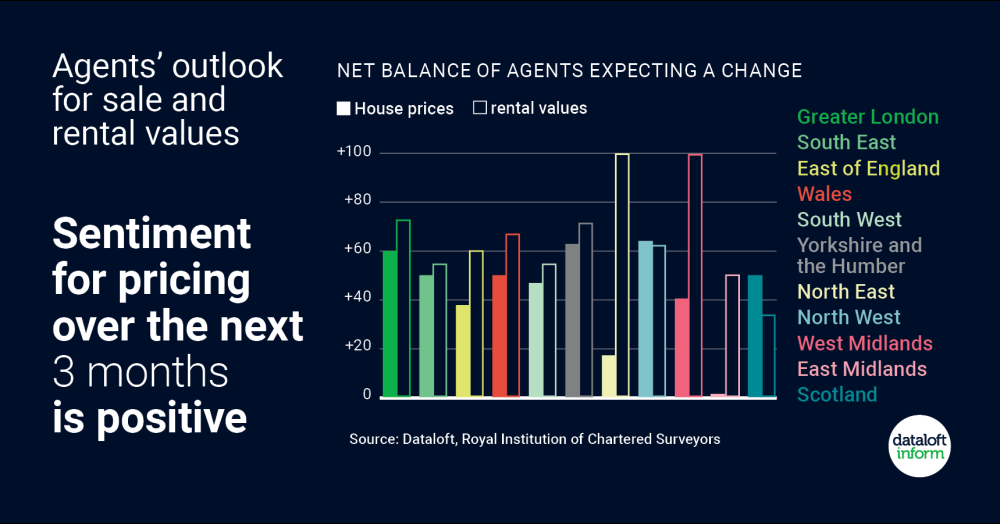
  • House prices and rental values are expected to rise across most of the UK over the next three months, based on the latest RICS sentiment survey.
  • All surveyors in the North and West Midlands thought rents would rise over the next 3 months. Confidence for house price growth highest in Yorkshire & The Humber, North West and London.
  • Expectations of house price growth have risen despite the interest rate rise in December, as stock levels remain close to historic lows.
  • The continued imbalance in supply and demand is also the driving force behind rental growth. National 12 month rental growth projections now stand at 4.5%.
  • Source: Dataloft, RICS (net balance score is calculated by the proportion of survey respondents reporting a rise minus those reporting a fall in the given indicator)


Get in touch with us

The rental market remains active in May 2026, but conditions are changing. Demand is still strong, rent growth has eased, and tenant expectations are rising. Here is what landlords should be thinking about now.

Sir Keir Starmer’s resignation has added fresh uncertainty to the UK property market, but its impact will depend less on politics and more on how financial markets react to the next government’s economic plans. Mortgage rates, taxation and buyer confidence could all be influenced by what comes next. Please click the link to learn more

Against a noisy global backdrop, the UK housing market has quietly surged, posting its strongest week for sales agreed in 45 weeks. Demand hasn’t vanished, it has sharpened. Well-priced homes are moving fast, while overpriced listings linger, making strategy and timing more critical than ever.

What does Attleborough really look like beyond house prices? This map highlights where larger households are most common, revealing where families and shared living arrangements are concentrated. The pattern shows how different neighbourhoods function as distinct micro markets, each shaped by the people who live there. Click to learn more...