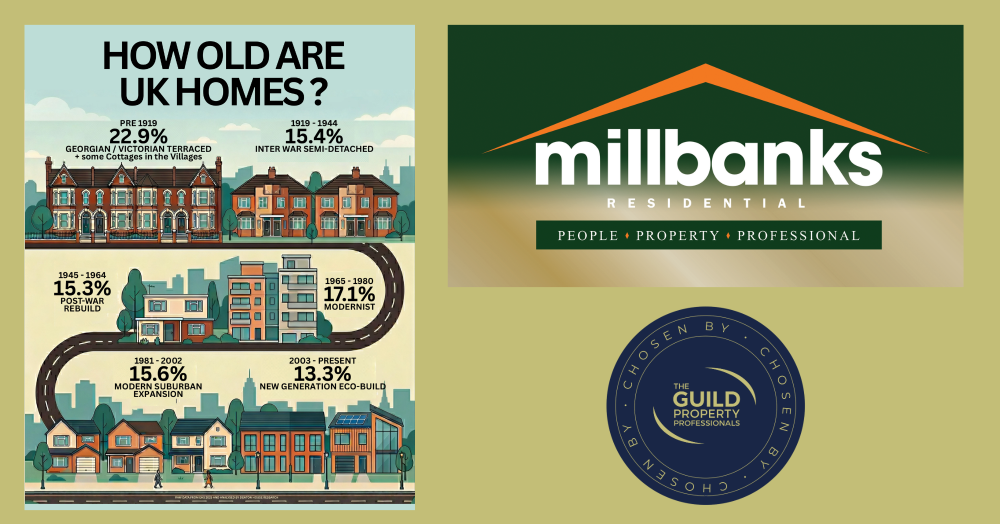
'How old is your home'
The age of a home shapes far more than its appearance. It influences value, demand, running costs and buyer appeal. Across the UK, housing stock spans generations, each with its own strengths and trade offs. Understanding where your home fits is key. Please read the article to learn more
The age of a home tells a story. Not just about bricks and mortar, but about construction standards, buyer expectations, maintenance costs and ultimately value.
Across the UK, just under a quarter of homes were built before 1919. These properties, often Victorian and Edwardian, remain a significant part of our housing stock. They bring character, generous proportions and period features, yet can also present challenges around insulation, layout and ongoing upkeep.
Move forward through the decades and you see the impact of social change and government policy. Interwar housing, post war rebuilding and the housebuilding boom of the 1960s and 1970s together account for a substantial share of what we sell today. Many of these homes were built quickly to meet demand, yet they often offer strong fundamentals, sensible room sizes and established plots.
Properties built from the 1980s onwards represent a slightly smaller slice of the national mix. These tend to offer more modern layouts, improved energy efficiency and lower immediate maintenance, which can appeal strongly to first time buyers and downsizers alike.
What matters locally, however, is that every town and city has its own profile. Some areas are dominated by pre 1919 terraces. Others are largely post-war estates. Some commuter belts have seen significant development since 2000, while historic market towns may have very little modern stock at all.
For sellers, understanding this mix is crucial. Your home is not judged in isolation; it is judged against the competing stock in your specific local market. For buyers, it helps explain pricing, energy performance and future investment requirements.
This is where detailed local knowledge of Attleborough makes a difference. Knowing how your property fits within the age profile of Attleborough enables more accurate pricing, sharper marketing and better-informed decisions for everyone involved.