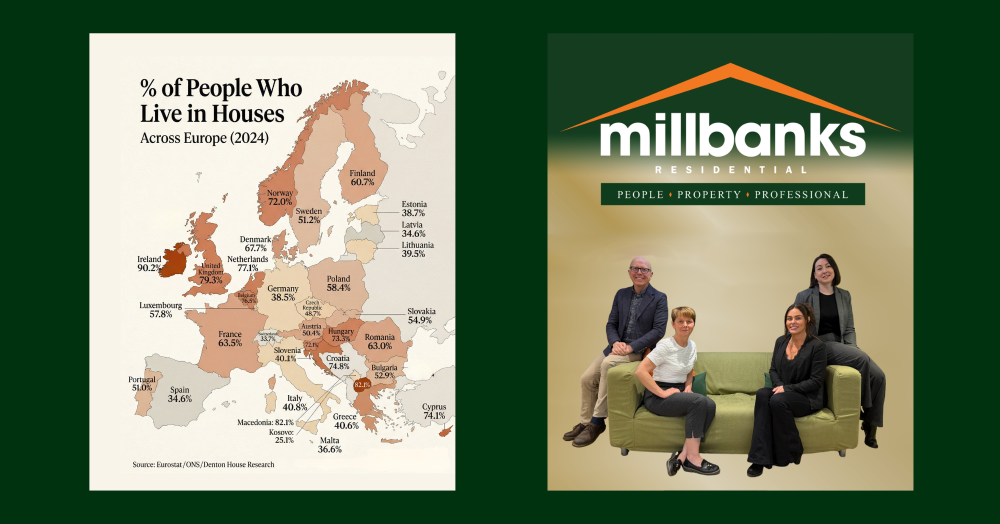
Percentage of People in Europe who live in Houses
Across Europe, where people live reveals striking contrasts. The UK leans heavily towards houses, unlike many countries where apartments dominate. This shapes demand, pricing and expectations at home. Is it culture or design? The answer may surprise you… read on to explore the full story.
Across Europe, where people live tells a fascinating story about culture, land use, and housing supply.
At one end of the spectrum, Ireland stands out, with over 90% of people living in houses. That is the highest in Europe and reflects a long standing preference for low density living, combined with more available land and a strong tradition of home ownership in houses rather than flats.
At the other end, Kosovo sits at just 25.1%, making it the lowest. Much of Eastern and parts of Southern Europe lean more heavily towards apartment living, often shaped by historic urban planning, economic factors, and higher density city living.
Looking at the larger Countries, there are some notable contrasts. United Kingdom comes in at 79.3%, placing it firmly towards the higher end and much closer to Ireland than to mainland Europe. In comparison, Germany is at just 38.5%, Spain at 34.6%, and Italy at 40.8%. These are all countries where apartment living dominates, particularly in urban centres.
Meanwhile, France at 63.5% and Poland at 58.4% sit somewhere in the middle, balancing houses and flats more evenly.
The UK’s bias towards houses is not the global norm. It shapes buyer expectations, land values, and pricing dynamics. In simple terms, we operate in a market where the “house” remains king, and that continues to influence everything from demand patterns to long term housing policy debates.
Is the UK’s love affair with houses cultural, or just a reflection of how we have built our towns and cities? Do share your thoughts.